


But that is too typical for a guy named Patrick Long. On Valentine's day, he
proposed to his girlfriend, Jenny
Longman, by using a look-alike of
Wordament – a word puzzle game
for Windows Phone that the girl's favourite.
In Wordament, words are hidden
inside of a 4 by 4 letter grid, and the
player's goal is to find as many of
them as possible. And with the help of
a software tool called Microsoft
Expression Blend, Pattrick coded his look-alike from scratch making it work
similarly to the real game. As you
might expect, he programmed it so
that the sentence hidden in the
puzzle reads "Will you marry me?"
when solved.
This unordinary proposal ended with the sweetest YES!
source: Windows Phone Blog


The screenshot was extracted from an email from RIM
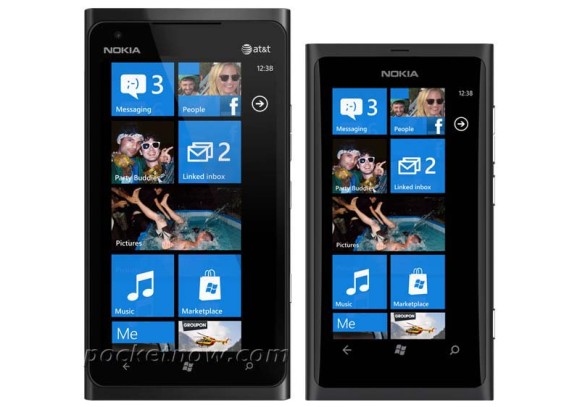
Nokia Ace will be hopefully available worldwide as Lumia 90 . The smartphone will run on a 1.4GHz Scorpion CPU and 512MB of RAM. The screen seems to be on the 4.3" category, while the battery is rumored to have 1830mAh capacity. The phone is also expected to pack T-Mobile's 1700 MHz 3G band. And other goodies Nokia has on its other smartphones.
The Nokia Ace will weigh 160 grams, while having similar thickness as the Lumia 800 at 12mm. The Windows Phone Mango Nokia flagship smartphone is expected to hit the shelves in March.
German researchers armed with smoking candles have come up with a cheap and easy way to coat surfaces so that oil droplets bounce or roll right off. The advance could eventually lead to eyeglass coatings and tablet computer screens that can evade the mark of even the greasiest fingerprints.
Making surfaces able to repel fluids—whether water- or oil-based—is also important for industrial and biomedical applications. But it's harder to make a surface that repels oil or organic solvents as opposed to water because oil has a far lower surface tension than water.
What's required is a very specific type of surface roughness—akin to the branches of a budding tree—that achieves oil-repellency. This has been understood for some time, but it has been difficult to fabricate such a texture. Earlier work at MIT and elsewhere involved complex nanolithographic techniques.
 |
| Grease gone: A five-micrometer drop of a solvent bounces off a surface coated with the new material. Max Planck Institute for Polymer Research, Hans-Jurgen Butt |
Researchers at the Max Planck Institute for Polymer Research in Mainz, in a paper published today in the journal Science, say they've come up with a simpler way, using a combination of candle soot and silica baked at just the right temperature.
Neelesh Patankar, a mechanical engineer at Northwestern University, says the work is an important step toward finding a commercially viable way to make such materials. "It has been known what surface chemistry as well as geometries would work" to repel oils, he says. "This work shows a good way to make such coatings with the right kind of practically relevant properties."
source: technologyreview

The total number of mobile applications is close to reaching a millionacross the four biggest platforms: iOS, Android, Windows Phone and BlackBerry, according to a report by analytical company Mobilewalla. It doesn’t take into account Symbian applications from the Nokia Ovi Store, which would have tipped the number over a million.
Obviously, iOS and the App Store are still the dominant players with a total of the whopping 590,138 applications available. This makes up 60% of all apps across the four biggest platforms with Android only a distant runner-up with its 320,315 apps, nearly half those on iOS.
 |